The Kachin Gambit

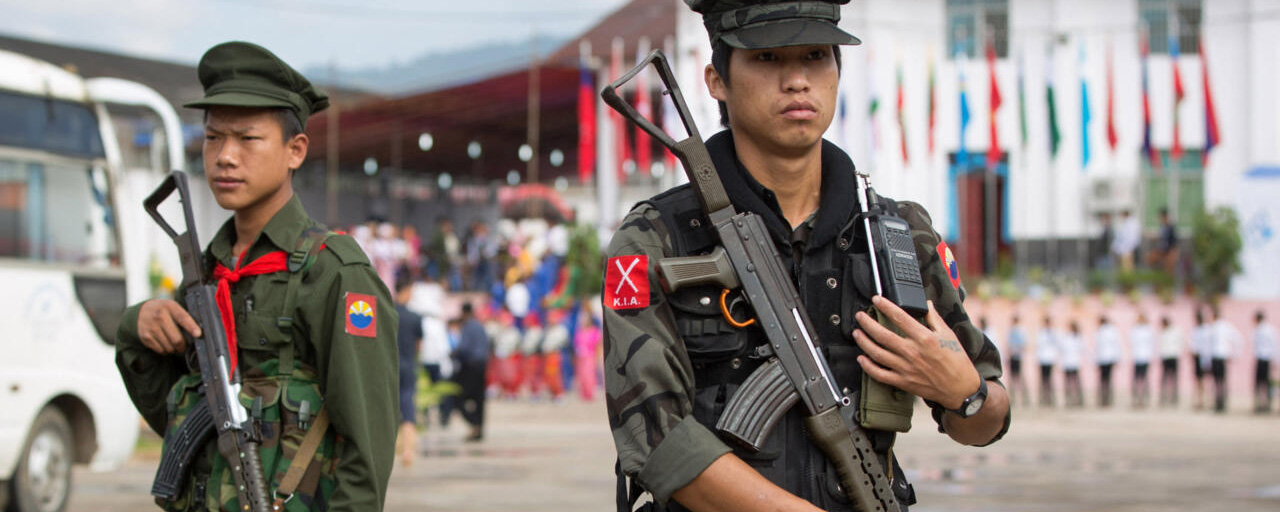
Most Americans would struggle to pinpoint Myanmar on a map, let alone its rugged, northernmost state of Kachin. Yet, this mountainous frontier, wedged precariously between the rising powers of China and India, has once again become a geopolitical flashpoint. For Washington's strategists, it glitters with opportunity—a volatile crossroads where old alliances, coveted minerals, and Chinese vulnerabilities converge. But for anyone with a sense of history, it is a chilling reminder of America’s tendency to wade into other people's wars, misread complex local dynamics, and leave behind a legacy of wreckage more enduring than its promises.
This is not America’s first dance in Kachin. During the Second World War, the Office of Strategic Services—the CIA’s forerunner—forged a pragmatic alliance with Kachin fighters to harass Japanese forces in the dense Burmese jungles. These resolute, ragtag warriors, later immortalized as the ‘Kachin Rangers,’ became the eyes and ears for inexperienced American soldiers who could barely survive the terrain without their guidance. To this day, Kachin families recount tales of their grandfathers fighting alongside young Americans who knew more about baseball than a machete. It was a bond forged in shared struggle, a sentiment so powerful that a surviving veteran could declare decades later, ‘It is my duty to help because the Americans liberated us.’
Yet, this bond has been repeatedly exploited. From Cold War experiments arming Kuomintang remnants in Myanmar to the subtle flirtations with the Kachin Independence Army (KIA) today, Washington has treated this historical affinity as a strategic lever to be pulled whenever convenient.
Fast forward to October 2024, when the KIA captured two key towns, Chipwi and Pangwa. Their strategic value lies not just in territory, but in what lies beneath it: rare earth elements. These minerals, the lifeblood of the 21st-century economy, are essential for everything from smartphones to F-35 fighter jets. Beijing, in its quest for technological supremacy, relies heavily on imports from Myanmar to supplement its own near-monopoly on global production. By February 2025, with the KIA in control, Chinese rare earth imports from Myanmar had plunged by nearly 90 percent.
For Washington, this was music to the ears. Long unnerved by its own dependence on Chinese rare earths, the prospect of China's backyard supply chain being throttled by an armed group with historical ties to the West seemed like a strategic masterstroke. But what appears as clever geopolitics risks becoming reckless overreach. Covertly encouraging armed movements to disrupt a rival’s access to resources is a short-term gambit that historically produces long-term blowback. The CIA’s backing of the Afghan mujahideen in the 1980s helped expel the Soviets, only to empower extremists who later turned their guns on the United States. Myanmar’s labyrinthine ethnic conflicts offer a similarly combustible mix.
China, for its part, is deeply unsettled. For years, Beijing treated Myanmar’s military junta as a pliant partner, investing billions in pipelines and infrastructure to bypass the ‘Malacca dilemma’—the vulnerability of its energy imports to sea lanes patrolled by the US Navy. But the junta's grip is failing. Ethnic Armed Organizations (EAOs), from the KIA in the north to others along the borders, now control vast swathes of territory. Beijing’s client looks less like a stable partner and more like a sinking ship. The nightmare scenario for Beijing—a Christian-led, West-friendly militia controlling strategic minerals on its border—is fast becoming a reality.
This is precisely the kind of temptation Washington finds irresistible: a chance to weaken China without deploying Marines or spending trillions. The symbolism was not lost when US envoy Susan Stevenson visited Kachin-held areas in August 2025. Officially, her visit was humanitarian. Unofficially, it was a signal—a calculated probe into China’s soft underbelly.
Herein lies the perennial flaw of American foreign policy: hubris. Washington too often views complex foreign conflicts through a simplistic lens of opportunity. It sees the Kachin fighters as plucky underdogs in a grand morality play against authoritarianism, overlooking the messy reality that Myanmar’s ethnic conflicts are not neat democratic struggles. They are a chaotic tapestry of overlapping feuds—ethnic, religious, tribal, and commercial—that have raged for seven decades.
The KIA is not a Jeffersonian militia yearning for liberal democracy. It is a battle-hardened force with its own hierarchy, revenue streams, and strategic interests. While its leadership is predominantly Christian, with roots tracing back to 19th-century American Baptist missionaries, this cultural affinity is a poor predictor of political alignment. Washington should have learned by now not to conflate religious familiarity with strategic reliability.
The American record on this front is abysmal. In Vietnam, the US mistook Catholic elites for natural allies, ignoring the powerful nationalist currents driving the conflict. In Iraq, it assumed Shiite exiles would build a democracy, only to unleash sectarian carnage. In Afghanistan, it treated Pashtun warlords as partners in governance, even as they hollowed out the very state America was trying to build. Why would Myanmar be any different?