Axis of Alarm: Saudi-Pakistan Pact

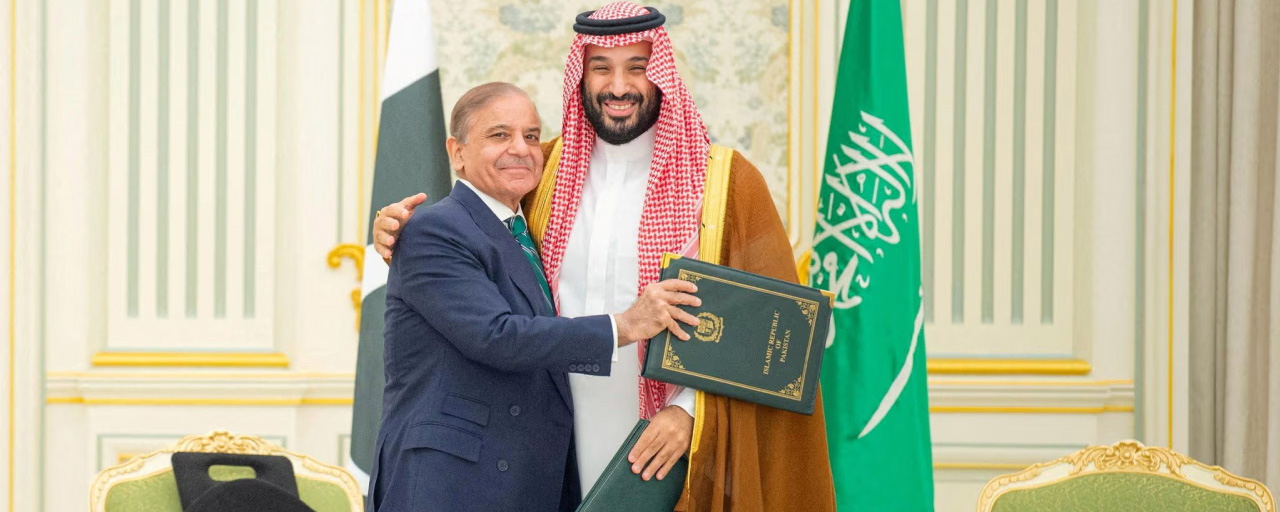
The announcement by Pakistan and Saudi Arabia of the conclusion of a Strategic Mutual Defence Agreement has, expectedly, rankled nerves in New Delhi. In the statement’s text, the part which says ‘any aggression against either country shall be considered an aggression against both’ has raised concerns and questions alike, specifically over the trajectory of the India-Saudi dynamic.
India has mobilised a global diplomatic effort to isolate Pakistan following the April 2025 terror attack in Pahalgam, Jammu and Kashmir, which led to the largest military exchange between the two countries since 1971. However, an aim to internationally quarantine Pakistan has fallen short. The Saudi-Pakistan deal is another feather in Islamabad’s cap since then.
In May, as Operation Sindoor was launched to militarily target terrorist camps inside Pakistan, diplomats from Saudi Arabia and Iran were in New Delhi as missiles began to fly across the border. Prime Minister Narendra Modi was in Riyadh on an official visit during this period and had rushed back to India due to the terror strike. Saudi Minister of State for Foreign Affairs, Adel al-Jubeir arrived soon after to meet External Affairs Minister S. Jaishankar. But Mr. Adel al-Jubeir’s meeting at the Prime Minister’s Office turned heads, and while both sides remained tight-lipped, Riyadh, in all likelihood, tried to diffuse an escalating situation.
Linked to geopolitical changes
Beyond South Asia, the events above are also a window into the geopolitical fracas unravelling on multiple fronts in West Asia ever since the terror attack by Hamas against Israel, in October 2023, which has pushed a reorienting of strategic calculation across the wider region. Fast forward to September, and the Riyadh-Islamabad agreement is being downplayed but has wider geopolitical reverberations.
Indian interests are peripheral for Riyadh, but for Pakistan, this deal kill two birds with one stone. It rekindles lost sheen with the Kingdom and challenges New Delhi’s security concerns simultaneously.
The pact is also a return to normal for what was a strained time between the Kingdom and Pakistan, the Islamic world’s only nuclear weapons power. In 2015, the then Nawaz Sharif government had refused to send troops to join Saudi’s campaign against the Iran-backed Houthi militia in Yemen. For decades, the Saudis have seen the Pakistani military, with its extensive real-world experience in warfare — most of which has come against India — as the best force to strengthen its own domestic and regional security. Moreover, with the United States increasingly being viewed as an unreliable military partner in West Asia, Riyadh is back shopping in its traditional stomping grounds. For Islamabad, the nuclear file is once again delivering dividends, albeit more as a matter of chance than design. Nonetheless, its effectiveness has been on display from Washington to Riyadh.
Reports in the western press have suggested that this deal had been in the making for around three years. In a statement, India’s Ministry of External Affairs said that it had been aware that such an agreement was under consideration between the two countries. For long, Pakistan, the only Islamic country in the world with nuclear weapons, has been touted as a supermarket for Riyadh’s potential nuclear requirements. The ‘12-day war’ between Israel and Iran, and both taking turns to launch weapons at Qatar, has further raised the stakes.
The fundamentals are solid
Beyond the surface, however, the Saudi-Pakistan pact is representative of multiple changes taking place in the international order. First and foremost, there is a false understanding of India’s bulging outreach to West Asia that an institutional wedge can be installed between Islamabad and the Arab states. These bilaterals are based on Islam, ideology, and theological principles. In Saudi and Pakistan’s case, it is a further strengthening around Sunnism. The fundamentals of this relationship are unbreakable. Second, Riyadh is now chasing strategic autonomy, multipolarity, and multialignment, all stated foreign policy aims and theories India wishes to implement as its core tenets to become a major power. This blueprint is aspirational to many others, and often, will put major partner states on the opposite end of Indian strategic interests.
The message for India
The challenge raised by the Saudi-Pakistan formalisation for the centrality of the ‘Islamic bomb’, a term coined by the Pakistani press in the early 1980s, may not be immense, but is a trailer of how the geopolitical chessboard is being stacked. It also represents a core challenge for India, that its culturally risk-averse strategic thought and the slow pace at which this is changing, are increasingly detached from prevailing realities. The Indian leadership needs to onboard risks that come with both the embrace and mobilisation of power. Else, India risks losing traction if fence-sitting remains the chosen path and there is an adoption of an idealistic view of playing the role of ‘chief pacifist’ chokeholds strategic choices.
The world is being re-shaped and will not wait for what India believes is going to be ‘its time’. The Saudi-Pakistan pact is Islamabad — and more specifically the Pakistan Army — using disruptions and crevasses in the global and Western order, to its merit. Another opportunity to reshape how the world functions may not return this century. It is now when Indian calculations need to be right and it needs to act with resolve.
Kabir Taneja is the Associate Director and Fellow at the Strategic Studies Programme at the Observer Research Foundation.
This article is First featured in The Hindu, we are delighted to present this article in Cult Current with full attribution.