DELHI BLAST : The Explosive Triangle
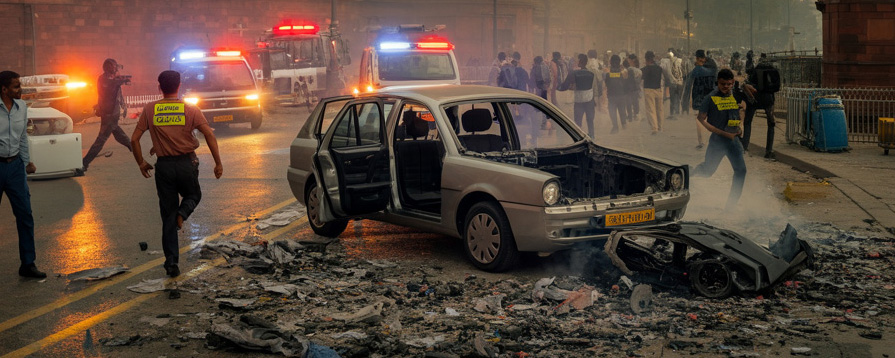
On the evening of November 10, 2025, as the Delhi sky was bathed in a haze of smog and the lights of the historic Red Fort, a massive explosion didn't just rattle the capital’s ground but pushed the discourse on India's national security into a new and terrifying chapter. The attack, unfolding in the shadow of the Red Fort—the symbol of India’s sovereignty and power—was not merely a blast; it was an open challenge to Indian democracy and its security agencies. As the Hyundai i20 car was blown to smithereens, 14 innocent lives were lost. Yet, as the plume of smoke settled, the truth that emerged was far more toxic than the smell of gunpowder.
This conspiracy was not hatched by unlettered, misguided youths, but by individuals from society's most prestigious profession—Doctors. When hands trained to hold stethoscopes grip detonators instead, it is a sign that terrorism has fundamentally altered its strategy. Security agencies have termed this ‘White-Collar Terror.’ However, as the layers of this incident peel away, the needle of suspicion does not stop at Pakistan alone; it traces the map of a vast international conspiracy stretching from Ankara in Turkey to the borders of Bangladesh.
The Doctor Module: ‘Gods on Earth’ or Merchants of Death?
The most disturbing aspect of this tragedy is the ‘Faridabad Doctor Module.’ The role of the main accused, Dr. Umar un-Nabi (whose body was shredded in the blast), and his associates—Dr. Muzammil and Dr. Shaheen Shahid (known as ‘Madam Surgeon’)—has proven that radicalization has moved out from the four walls of madrasas and infiltrated the air-conditioned rooms of medical colleges and universities.
Al-Falah University in Faridabad, which should have been a center of education, became the ‘nerve center’ of this terror network. It is deeply alarming that Dr. Umar, who had been terminated from a hospital in Anantnag, Kashmir, due to a patient's death, drove a car laden with explosives across Delhi-NCR for 11 hours without fear. This fact points to a grave failure in both our Human Intelligence (HUMINT) and technical surveillance.
The inclusion of doctors in terror networks is part of a calculated ‘Talent Hunt’ strategy by Jaish-e-Mohammed (JeM). Being medical professionals, they have easy access to chemicals (like Ammonium Nitrate), they attract less suspicion in society, and they can even fund the organization through their earnings. Dr. Shaheen Shahid leading the women's wing as ‘Madam Surgeon’ demonstrates that the old parameters of gender and professional profiling in terrorism have been demolished.
The Web of ‘Ukasa’: The Turkey Connection and Erdogan’s Vision
The most explosive revelation in the Red Fort blast probe is the Turkey Connection. A handler named ‘Ukasa’ (Arabic for Spider) was directing this entire network from Ankara. According to investigative agencies, the accused traveled to Turkey in 2022, where they met their foreign masters.
Turkey’s involvement in this conspiracy is not just a criminal matter for India, but a geopolitical warning. In recent years, under the leadership of Recep Tayyip Erdogan, Turkey has harbored ambitions of positioning itself as the new Caliph of the Islamic world. From vocal support for Pakistan on the Kashmir issue to now allowing Ankara to be used as a logistical and financial hub for terror attacks on Indian soil, this marks a ‘turning point’ in India-Turkey relations.
Turkey is being used like a ‘remote control.’ Instructions were being beamed from Ankara to Faridabad via high-encryption apps like ‘Session.’ This proves that Turkey is no longer just a diplomatic friend to Pakistan but has become an active participant in hybrid warfare against India. India must now accept that a new and capable adversary is rising in West Asia, one that exploits the shield of being a NATO member.
Pakistan: Old Enemy, New Tricks, and ‘Digital Spikes’
Even if the handler sits in Turkey, the source of the terror ideology and the smell of gunpowder remains Pakistan. The 68 suspicious mobile numbers active in the Red Fort parking area at the time of the blast were linked to ‘IP Clusters’ in Pakistan and Turkey. By using "Server Hopping" and "Virtual Numbers," Jaish-e-Mohammed attempted to ensure that all digital footprints were erased.
The reference to a response to "Operation Sindoor" in posters and plans for a major attack around December 6 (the anniversary of the Babri demolition)—dubbed the "D-6 Mission"—indicates that Pakistan's 'Deep State' (ISI and the Army) is now resorting to communal symbols to disrupt India’s internal stability. This attack is a desperate attempt to tarnish India's economic progress and global image.
Bangladesh: The Third Front and the Threat of ‘Encirclement’
Lashkar-e-Taiba commander Saifullah Saif’s claim that "Bangladesh will be used as a launchpad" is a ringing alarm bell for India. Taking advantage of political instability and the rise of radical elements in Bangladesh, Pakistan is deepening its roots there.
If we view this Turkey-Pakistan-Bangladesh nexus collectively, it presents a severe strategic threat to India’s ‘Chicken’s Neck’ (Siliguri Corridor) and eastern borders. This can be termed a strategy of ‘Encirclement.’ With Pakistan in the West, Turkey providing digital and logistical support from the Northwest, and Bangladesh as a potential launchpad in the East—this triangle could create a "Three-Front War" scenario for Indian security agencies, one fought not with traditional armies, but through terror and insurgency.
Technical Warfare and Intelligence Failure: A Self-Analysis
This attack has also exposed that we are living in the era of ‘Fifth Generation Warfare.’ Intercepting terror communications via apps like Telegram, Signal, and Session is becoming increasingly difficult. Handlers like ‘Ukasa’ sit in Turkey and turn a doctor in India into a suicide bomber, while our agencies remain in the dark.
300 kilograms of explosives are still missing. A car laden with explosives passed through the capital’s most sensitive zones (India Gate, Kartavya Path) and was not intercepted. This highlights a lack of coordination between ‘Beat Policing’ and ‘Electronic Surveillance.’ The question is inevitable: Are we technically capable enough to decode ‘Server Hopping’ and ‘Data Spikes’ in real-time?
Emotional and Social Impact: A Crisis of Trust
From the perspective of an Indian citizen, this event is heartbreaking. If a doctor, whom society regards as a ‘Messiah,’ becomes bent on taking lives, who can the common man trust? This is not just a security crisis; it is a social crisis of trust. When the highly educated class—engineers, doctors, professors—chooses the path of radicalization, it dismisses the argument that poverty and illiteracy are the roots of terrorism. This is an ideological virus that is now infecting the intellectual class.
Future Direction: India’s Response and Diplomatic Challenges
Following this incident, a paradigm shift is required in India’s foreign and security policy. India must review its relations with Turkey. A diplomatic message must be sent that the use of Ankara for anti-India activities will not be tolerated. India should deepen its strategic partnerships with Turkey’s adversaries (such as Greece, Cyprus, and Armenia).
Simultaneously, beyond surgical strikes or air strikes, India must continue the policy of diplomatically and economically isolating Pakistan. The time has come to develop offensive capabilities against Pakistan in the ‘Cyber and Space’ domains. Furthermore, regardless of who is in power in Dhaka, India must work with the security apparatus there to ensure that Bangladeshi soil is not used against India.
Post-incident, a thorough investigation of institutions like Al-Falah University is mandatory. A strict surveillance mechanism must be established to prevent the infiltration of radicalism into educational institutions. Moreover, finding the missing 300 kg of explosives must now be a national priority; otherwise, the danger has not yet passed.
Conclusion
The smoke marks on the walls of the Red Fort may wash away with the rain, but the questions raised by this attack will not be easily erased. The explosion of Dr. Umar un-Nabi’s car was not just a blast of RDX; it was an explosion of the illusion that we are safe.
Today, India stands at a crossroad where it must fight not only to protect its borders but also battle the ‘sleeper cells’ breeding within its own society. To slash through this web spreading from Turkey to Pakistan, India must adopt an unprecedented blend of ‘Chanakya Niti’ and modern technology. This battle is no longer just for soldiers, but for every aware citizen, intelligence officer, and policymaker. We must ensure that the sound echoing from the ramparts of the Red Fort is always that of ‘Jai Hind,’ and never that of a terror blast.
This is a time to be emotional, but also a time to be ruthless. The sacrifice of our 14 citizens must not go in vain. This bloodshed cannot bow India down; rather, it will forge our resolve into steel—to break every hand of terror, whether it is in a bunker in Rawalpindi, a plush office in Ankara, or a clinic in our own neighborhood.