

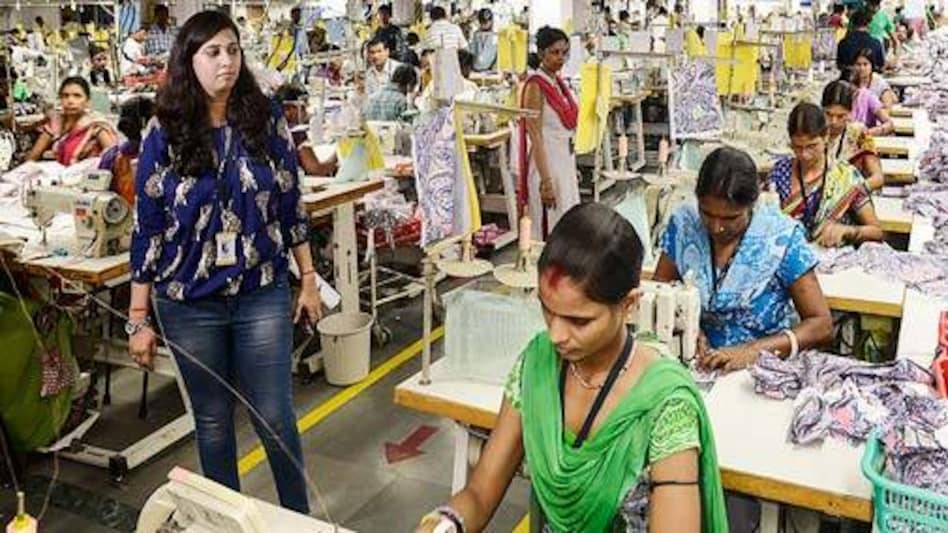
1. The Arithmetic — Who gets what?
The Indian textile industry is worth $55 bn, employs 45 million directly, second after agriculture. But its math is brutal.
Take a standard shirt that sells for Rs 1,500 in a mall: -
- Raw material: Cotton, yarn, fabric — 50-60% of cost. A 10% jump in cotton price wipes out a mill's entire profit.
- Labour:10-15% of cost, but most compressed. In Noida, workers earn Rs 8,000-13,000 for 10-16 hour days. Artisans doing zari for a Rs 4 lakh bridal lehenga get Rs 15 per hour — 1-5% of retail price.
- Power, maintenance, overhead: 20% -
- Net profit for mill:* 4-12%. On good years, Arvind, Gokaldas, Pearl Global push 11-12%. On bad years, 2%.
Q1 FY27 tells the story: Arvind reported 25% revenue growth to Rs 2,501 cr, but EBITDA margin fell to 8.0% because of Rs 19 cr input inflation. Pearl Global's revenue up 24.5% to Rs 1,528 cr, but its India margin fell from 7.3% to 6.6% after Haryana hiked minimum wages 38% and Noida 21%. Gokaldas absorbed Rs 20 cr extra wage cost in one quarter.
Companies' response? Automate or migrate. Pearl shifts orders from Haryana to MP and Bihar. Arvind invests in automated cutting. The classic Indian industrial move: don't raise wages, move to where wages are lower.
For worker: Rs 90 a month? No, Rs 90 a day now. But in Karur, Shobha Kiribakaran still makes $90 a month — Rs 7,500 — for 6 days a week, 9 to 6, packing aprons for Danish brand. She has done it for 10 years.
2. The History They Buried — From Girangaon to Gurgaon
India's textile industry was born in strikes. -
- 1918, Ahmedabad: Gandhi's first fast for mill workers' 35% wage hike. -
1982, Bombay: The mother of all strikes. On Jan 18, 1982, 250,000 workers from 65 mills in Girangaon — Parel, Lalbaug, Lower Parel — walked out under Dr Datta Samant. Demands: Rs 200-300 wage hike, bonus, and scrapping Bombay Industrial Relations Act that gave monopoly to Congress-linked RMMS union.
It lasted 18 months. Longest strike in Indian history. It ended with zero concessions. Mills shut — 50 permanently, 80 in next decade. 150,000 workers rendered jobless. Owners found land was more valuable than looms. Phoenix Mills became High Street Phoenix Mall. Kamala Mills became corporate park.
Samant was assassinated in 1997, allegedly by Chhota Rajan gang. The strike was buried twice: physically, as chawls demolished for towers, and historically, as textbooks call it a "failure of militant unionism" not a betrayal by state and capital who colluded to break RMMS and make way for real estate.
Pattern repeated. Tiruppur hosiery strikes of 1990s broken by shifting to powerloom contractors. Noida's 2024-26 wage protests — 260 protests nationwide this week in France, but in Noida workers asking for Rs 26,000 minimum were beaten, cases filed, media called it "law and order." Every time workers demanded share, industry called them cost and moved.
3. The Future — Worker Coding The Worker
Now the cruelest twist.
In Karur, Tamil Nadu — India's knitwear hub workers like Shobha are being handed GoPros. Three men walk factory floor, tell them to wear it. No explanation. Camera records every hand gesture, how she folds apron, checks stitch, packs.
This is egocentric data, millions of hours of human perspective needed to train garment robots. NPR reported this in Oct 2026, video went viral. Workers said: "We are training them on how to package aprons, how to do quality check."
Company Texworth didn't tell Shobha she was training her replacement. Some workers are paid Rs 220/hour for data, most just ordered.
In parallel, Swiss project BFH shows opposite model — no-code interfaces where worker herself programs cobot with visual blocks, building skill, not losing it.
"Keep workers in control of digital manufacturing," they say. India faces both paths:
Path A: Exploitation loop: Worker paid Rs 7,500 trains robot that will do her job in 2 years. Robot, developed by US/Chinese firms, will be deployed first in Vietnam, not India, because power cost high. But data comes from India because labour cheap, regulation loose. Astha Kapoor of Aapti Institute calls it "exploitation of labour."
Path B: Empowerment loop: Worker learns to code robot, becomes robot supervisor. Tamil Nadu's women-led electronics factories show it can work — 38% women workforce, 15% lower defect rate. If textile workers get 3-month reskilling to operate automated cutting, 3D prototyping, they keep jobs.
Economist Amit Basole warns: "We have a slow apparatus. Government not equipped for AI shock." India needs 8 million non-farm jobs a year, already failing. If 45 million textile jobs automate 20%, where do they go?
The future of the worker will be coded — literally — by the worker themselves. Question is, will she own the code?
When Girangaon workers struck in 1982, they wanted to own the union. In 2026, Karur workers should demand to own the data. Otherwise, history repeats: mills become malls, workers become training data, then forgotten.
*Tags:* #TextileIndustry #Girangaon #BombayTextileStrike #DattaSamant #Karur #GoPro #EgocentricData #WageTheft #Automation #FutureOfWork