

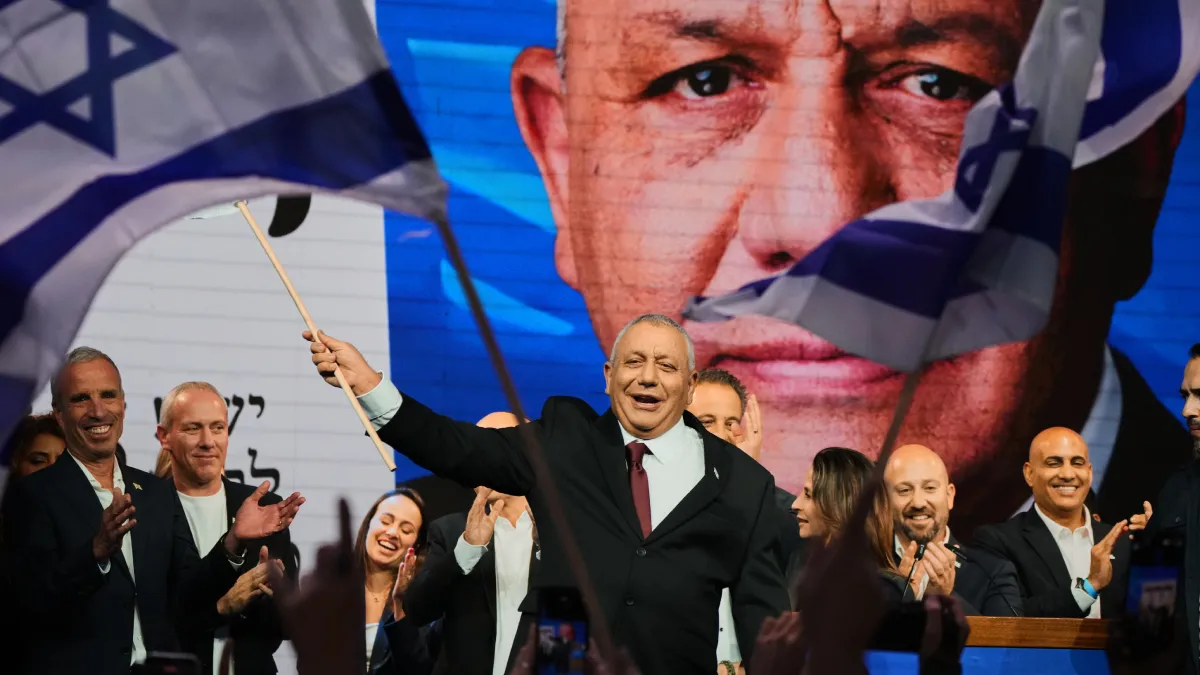
The Joint List alliance of Arab-led parties announced Thursday it will recommend opposition leader Gadi Eisenkot to President Isaac Herzog to form Israel's next government, a day after Ra'am did the same. Together, Arab-led parties won a record 19 seats in the 120-seat Knesset in the October 27 general election — 11 for Joint List, eight for Mansour Abbas-led Ra'am.
With their backing, Eisenkot — former IDF chief, leader of Yashar party — now commands 67 recommendations, six above the 61 majority threshold. His Jewish-led opposition bloc alone had 48 seats (Yashar 21, Naftali Bennett's B'Yachad 12, Democrats 8, Yisrael Beytenu 7). Netanyahu's bloc holds 53 seats, but his tally shrank to 46 after ultra-Orthodox ally United Torah Judaism (7 seats) refused to recommend either candidate.
The Joint List statement: "It will inform the President... this evening of its decision to recommend that Gadi Eisenkot be tasked with forming the government," aiming to prevent Netanyahu's return.
This is unprecedented. Arab turnout surged, which veteran lawmaker Ahmad Tibi called "an act of self-defense." Arab lists, representing Israel's 21% Arab minority, have never been kingmakers at this scale. In 2021, Ra'am briefly joined a coalition; this time both lists offer support from outside.
Tibi clarified: "We won't be part of the government. I don't want a ministerial post." Joint List conditions include a diplomatic process toward a Palestinian state, a funded plan to tackle violent crime in Arab towns (where 2026 homicides crossed 200), and ending home demolitions. Tibi urged Eisenkot to “be like [Yitzhak] Rabin.”
Yet contradictions loom. Eisenkot previously said Ra'am "will not be part of my next government" as they don't adhere to Zionist principles, and Yisrael Beytenu leader Avigdor Liberman ruled out any government reliant on Arab parties. So 67 recommendations do not equal a 67-seat coalition. Herzog, who certified results Wednesday after rejecting Likud fraud claims, has until November 11 to pick a mandate-holder, who then gets 28 days, plus 14-day extension, to form a government.
From an Indian lens — with 195 million Muslims and coalition experience — this mirrors how minority votes move from protest to pivotal. For India, which balances ties with Israel and Palestine, an Eisenkot government backed by Arab parties could be more open to a two-state push and less confrontational on Gaza and Iran, potentially easing oil and diaspora risks.
If Eisenkot succeeds, it will be Israel's first government formed with explicit Arab endorsement — a shift as seismic as 19 seats suggest.
*Tags:* #IsraelElection2026 #JointList #GadiEisenkot #Raam #ArabParties #Netanyahu #Knesset #19Seats #IsraeliPolitics #Palestine